

What are fleet cards?
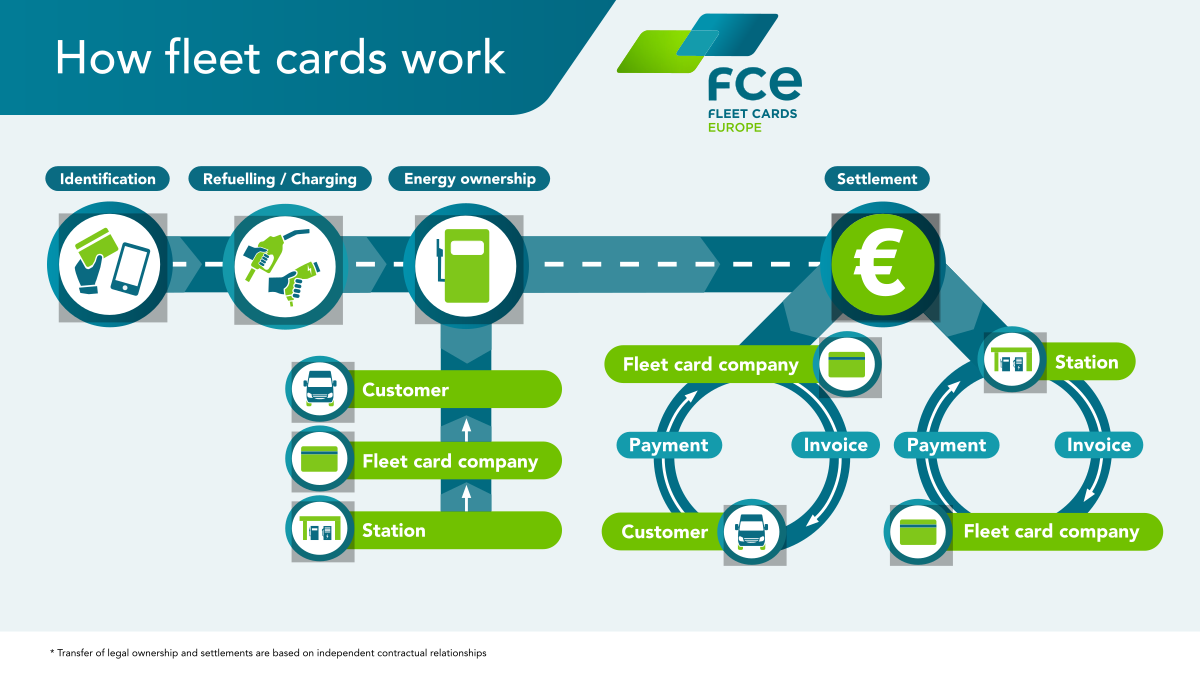
Fleet cards, whether physical or digital, are identification instruments for the purpose of obtaining vehicle-related goods and services, such as conventional and alternative energies, roadside assistance, toll charges, security services, parking and ferry fees.
Fleet cards have bespoke characteristics and special features that differentiate them from regular payment instruments. They specifically do not initiate the transfer of funds and are not consumer focused, but predominantly used on a business-to-business basis. Fleet cards are exempted under the Payments Services Directive as they give access to a very limited range of goods or services but given the unique nature of the business model where there is no contractual relationship between the fuel card company’s supplier and the end user, some EU Member States have even concluded further that fuel cards are not payment instruments and should be completely out of scope of the Directive.
The benefits of fleet cards
 Discounts
Transport companies can make significant financial savings by using fleet cards, enjoying fixed prices, wholesale discounts, loyalty programmes.
Simplified administration
All transactions for fuel, electricity, tolls or related services are tied into one easy-to-read invoice and can be viewed on an account management tool.
Transparency (reporting)
Transport companies can monitor and track all on-the-road expenses in “real time”. This means greater efficiency and performance for haulage companies able to, for example, optimise route-planning and reduce “empty runs”, which signifies fewer emissions and less costs.
VAT handling
Companies can easily manage their VAT obligations and apply for refunds. The cards also lower the risk of tax fraud, as tax authorities can easily check the validity of the invoices.
Control and security
Fleet cards are based on a closed loop or limited network and can only be used to access a very limited range of goods within fuel and service stations, giving the customer more control. Fleet card issuers enable cardholders to block, limit and place customer orders 24/7, thereby providing a high-level of security. For the driver, it is a safer alternative to carrying cash.
Enabling the future (beyond fossil fuels)
Customers can use fleet cards for environmentally compatible fuels, like hydrogen, autogas (LPG), natural gas (LNG and CNG) and e-Fuels as well as the charging of electric vehicles, contributing to the reduction of greenhouse emissions.
Convenience (speed and simplicity)
Identification of the customer when obtaining goods and services related to on-the-road mobility.
Liquidity (optimising cash-flow)
Reconciliation of on-the-road costs enables the transport enterprise to optimise their working capital, which increases business competitiveness, which has wider implications for the European economy.
Differences between payment cards and fleet cards


Fleet cards
Fleet card company
- Acts as a buyer/seller/supplier of goods and services
- Does not need payments license from the authorities
- Is not subject to supervision by the EBA/national supervisors according to PSD2 (PSD2 includes an exemption for fuel card issuers)
Commercial chain transaction based on civil law (in the event of deficiencies in performance, the fleet card user sues the fleet card company)
Purchase and sale of goods and services (as a part of the chain transaction)
Card with identification function, no payment function
Card holder
- Acts in the name and on behalf of the fleet card company
- Receives solely a delivery note at the “Point of Sale”
- Receives purchase invoice showing VAT exclusively from the fleet card company
Payment cards
Payment card issuer
- No seller/supplier of goods and services
- Needs payments license from the authorities
- Is subject to the supervision by the EBA/national supervisors (no utilization of the PSD2 exemption)
Financial transactions (in the event of deficiencies in performance, the payment card user does not sue the payment card issuer, but the mineral oil company)
Payment or granting credit (as a part of the financial transaction chain)
Card with payment function
Card holder
- Acts on his/her own behalf
- Receives a purchase invoice showing VAT exclusively at the “Point of sale”
- Receives debit notification/account statements from the payment card issuer
